

Fall in Love With Falling
If you don't love the part where you lose, you don't actually love the sport.

“99% of my training is falling.”
— Janja Garnbret, Red Bull Interview (2023)


Janja Garnbret — the most dominant competition climber alive — just told you that falling isn’t a bug in her training. It’s basically the whole program.
You will fall. And you’ll react one of a few ways, in order of how common they are: anger, embarrassment, demotivation... acceptance.
Only one of those reactions makes you a better climber and a happier one. Not surprisingly, it’s the rarest: acceptance.
Every climbing gym’s new-climber orientation includes a section on how to fall. Given that gravity is a force we’ve fought since birth (ask your mom’s lower back about gestation), it seems strange that gyms bother teaching something that’s going to happen no matter what.
Here’s how you get sunburnt when you skip sunblock.
Here’s how you get tired when you don’t rest.
Here’s how you fall when you don’t hold on.
Got it. You’ve graduated from the School of Uninterrupted Inertia. Here’s your diploma. Watch it fall if you let go of it.
Falling is easy. Falling well has to be taught. Roll from your butt to your back. Don’t stiff-arm the mat. Blah blah blah. Just let me climb, dammit.
Fine. Climb, you hypothetical rebel. But know this: most of your climbing will be falling. As much of a maverick as you are, bouldering means you’ll lose to gravity a lot more than you beat it.
“If you’re really disappointed and upset every time you fall off then you’re just going to have a miserable time.” — Hannah Morris, Catalyst Climbing (2024)
That’s the trap. Falling sucks in the moment — but if every single fall wrecks your mood, you’ve turned a bouldering session into a hundred tiny losses instead of a hundred tiny lessons.
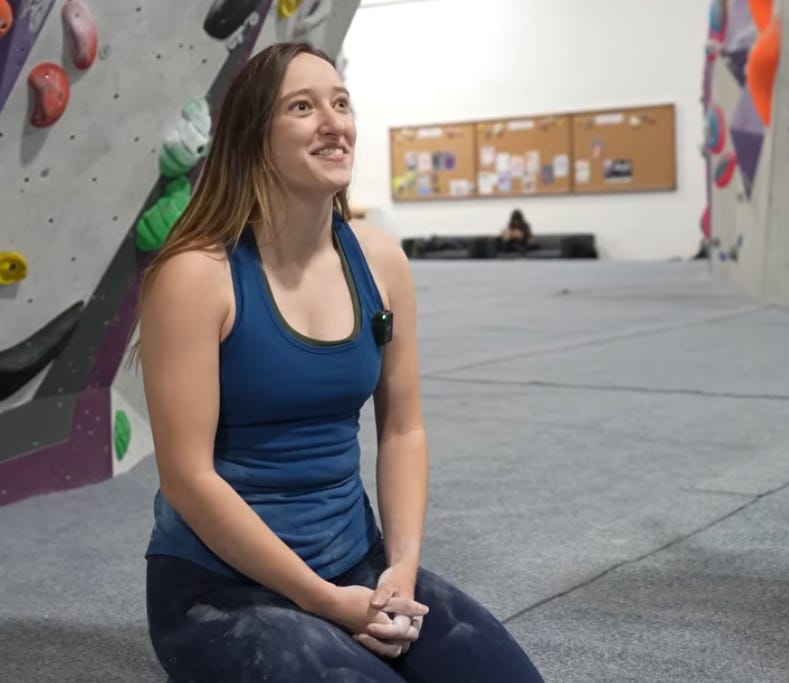
But the sooner you embrace falling, the sooner you actually embrace climbing. Otherwise you’re only loving 1% of the sport. It’s like saying you love swimming but hate the water — you just like moving your arms. That’s not loving swimming.
Think of falling as a loss condition, the way losing a race or a basketball game is. When your team loses, you can still respect the other team’s skill. You witnessed something better than you. In climbing, the wall is your rival — and when it beats you, that’s your cue to learn from it.
For me, that means going back to the hold that spit me off. I’ll climb up to it on easier holds from another route, then study it from every angle. Grip it from all sides. Dig into crevasses I’d ignored. Shift my body, try different positions. I explore everything that hold has to offer.
Then I try the problem again.
And if I fall, I accept it. And I try again.
Try this today
Next time you fall off a move, climb back up to that exact hold on an easier line and spend two minutes just gripping it from different angles before you try the move again.
Got any good bouldering tips of your own? Share articles or videos you’ve found helpful—I’d love to check them out.
The climbers: Janja Garnbret, Hannah Morris
The sources: Red Bull Interview (2023), Catalyst Climbing (2024)
Recently I had a lot of trouble with the acceptance part when I tried some boulders many times. But I couldn't find a way to get a beta that worked for me, because I am a short person.
It's very frustrating if you know how it is meant to be climbed and you see people do it easily, but for you it is just not possible this way or at least one grade harder..
I know it is just part of our sport and I also learned a lot of techniques very early on to adjust for my height and my lack of strength (at least this improved lol).