
Bouldering Tip: Look at the hold, dummy (Zach Richardson)

Note: I’ve received a few new subscribers to Sendship, thanks to the Beta Break card game Kickstarter that recently got funded. Welcome! I hope you enjoy the newsletter. In addition to updates about the Beta Break card game, you can expect curated tips from climbing pros, progress on my journey to learn to appreciate slab climbing, and other bouldering-related thoughts.
“It sounds a bit simple and silly, but you’ve got to look at the hold you’re going to.”
- Zach Richardson
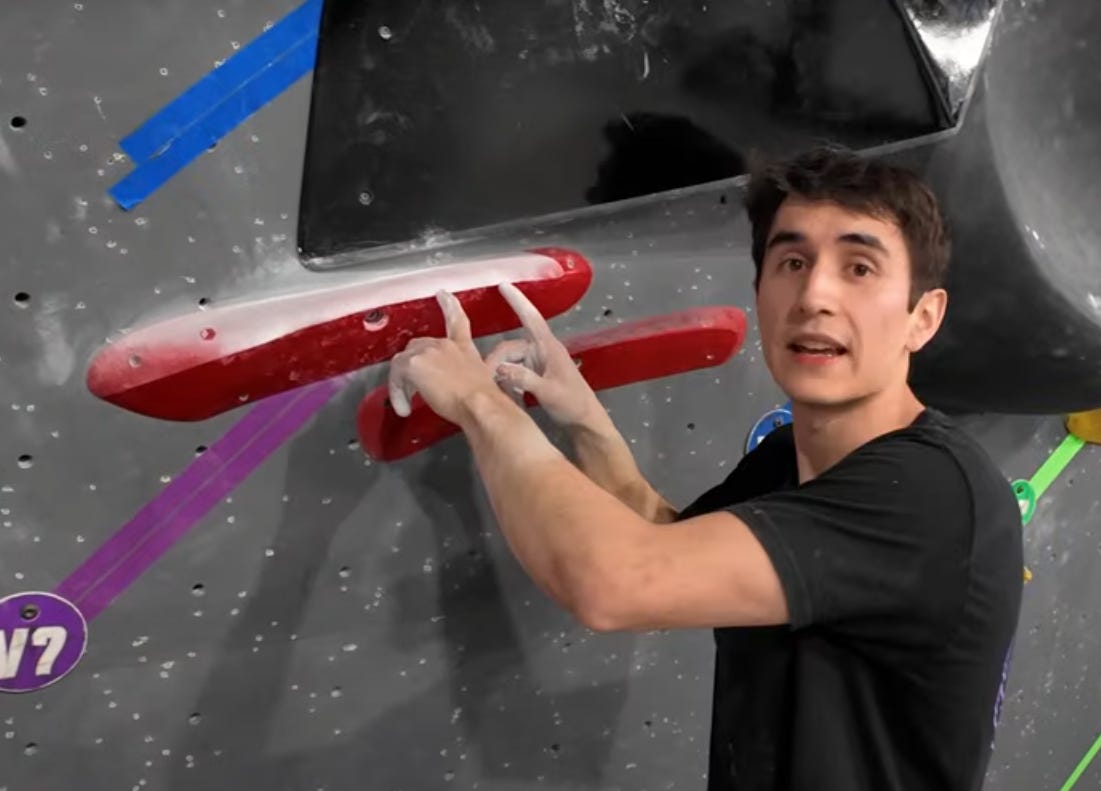
Climbing is an activity that demands precision. A beginner can get away with stomping up a ladder of jugs, but as holds become smaller and sparser, progress hinges on the ability to consistently target small holds.
Precision is mentally taxing, and humans have evolved to take shortcuts. We assume every snake is dangerous because a few are. Brand affinity lets us trust every product from a company based on limited experience. In climbing, we pay attention just long enough to secure a move before planning the next one. Even route reading—a beneficial practice—aims to nurture muscle memory to reduce thinking on the wall.
Precision doesn't come naturally. Worse, a lack of precision often doesn't stop us from sending many boulder problems. Many climbers who want to improve could benefit from being more precise, but they may not realize precision is the issue. We don't know what we don't know.
Precision doesn't come naturally.
In my ongoing series, "Slabsolutely Not," where I earnestly try to appreciate slab climbing, Zach Richardson offers a helpful piece of advice: "Look at the hold, dummy!" [Editor’s note: Zach did not say "dummy," but he should have!]
“Actually, what we do a lot when we are climbing is we dip into using our peripheral vision…with the blocked holds [editor’s note: but actually, with all holds], it’s actually very important that you stare precisely at where your hand is going to go. And this is going to help your brain, and your coordination, track your hand to hit your target.”
Precision is a weakness of mine. While I've worked on footwork precision, hand precision is less discussed. Hands are more dexterous, and imprecise placement can be adjusted with a quick finger shift. Feet, however, act more like a single limb, as toes aren't exposed for quick shifts. Therefore, foot placement is trained hard while hand placement is trained less. Zach’s video helped me realize the importance of precise hand placement, which is helped by looking at the damn hold!
I’ve been working the Kilter board a lot lately, which allows for controlled hand precision practice. I can say, with absolute certainty (slabsolute certainty?) that watching my hand meet a hand hold…truly watching it, without relying on peripheral vision…has increased my success rate.
However, if I'm ever caught off guard by a predator while drinking from a puddle, I’ll be sending my medical bills to Zach Richardson for training me to ignore my peripheral vision.
Do you have any bouldering tips to share? Leave links to articles or videos that you’ve found helpful.
Subscribe for weekly free tips from climbing pros.
The climber: Zach Richardson
The source: HOW TO CLIMB V7 • Analyzing essential V7 techniques